Is Amberwood at Holland Really Expensive? Why This D10 New Launch May Be the Wrong Project to Judge by PSF Alone
When buyers first hear about Amberwood at Holland, one number usually stands out:
Around $3,200 to $3,300 psf.
For some, the reaction is immediate:
“Isn’t that expensive?”
But that may be the wrong question to ask.
A better question is:
Is Amberwood expensive, or is it simply priced according to where Singapore’s prime residential market is heading?
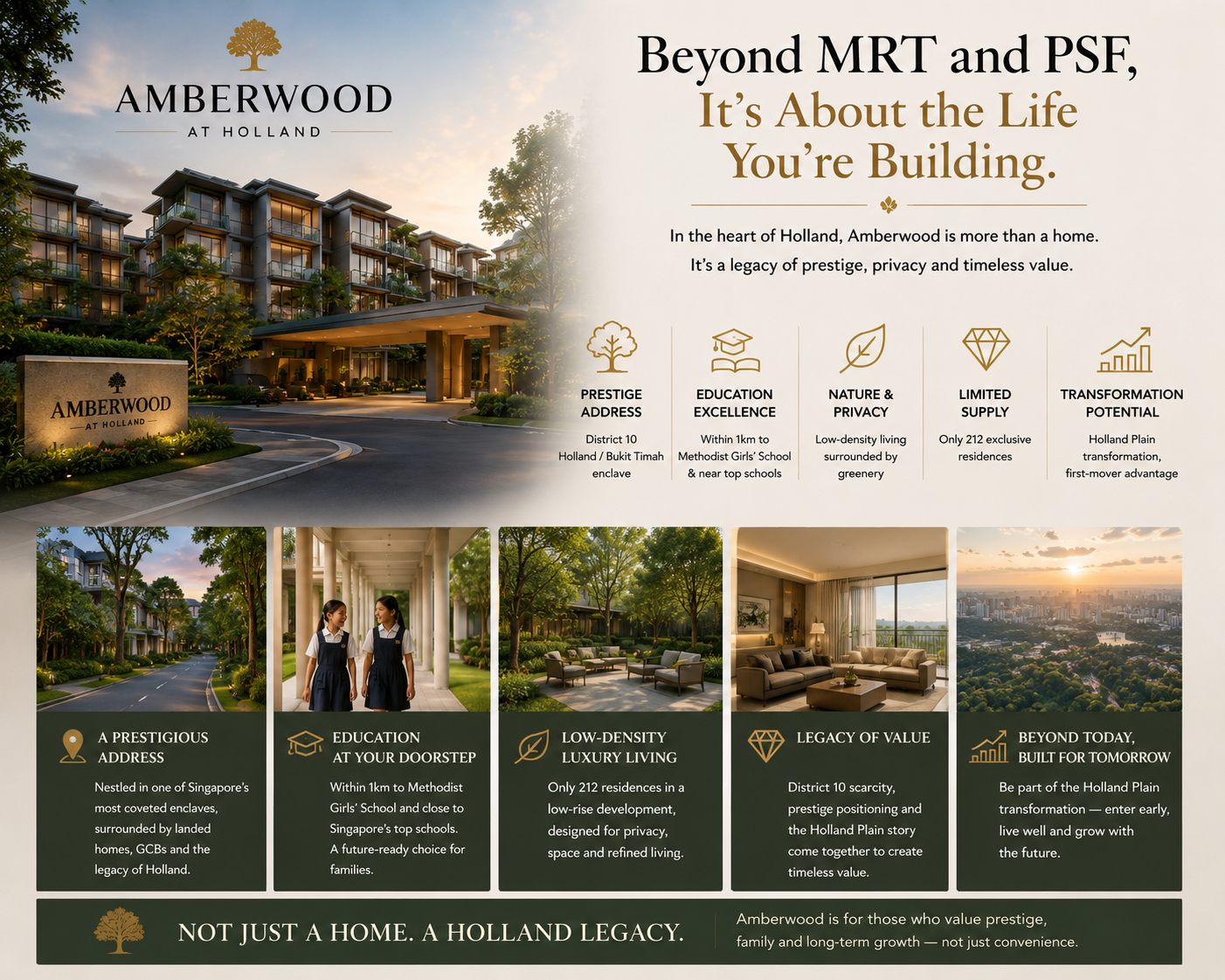
Amberwood sits within the Holland / Bukit Timah prestige belt, in a District 10 location where land scarcity, school proximity, low-density living, and long-term transformation potential matter as much as PSF. Based on the seminar deck, Amberwood is positioned around five key themes: market value, launch comparison, lease reset, prestige premium, and the Holland Plain transformation story.
What is Amberwood at Holland?
Amberwood at Holland is a new residential development positioned in the Holland enclave of District 10, one of Singapore’s most recognised prime residential districts.
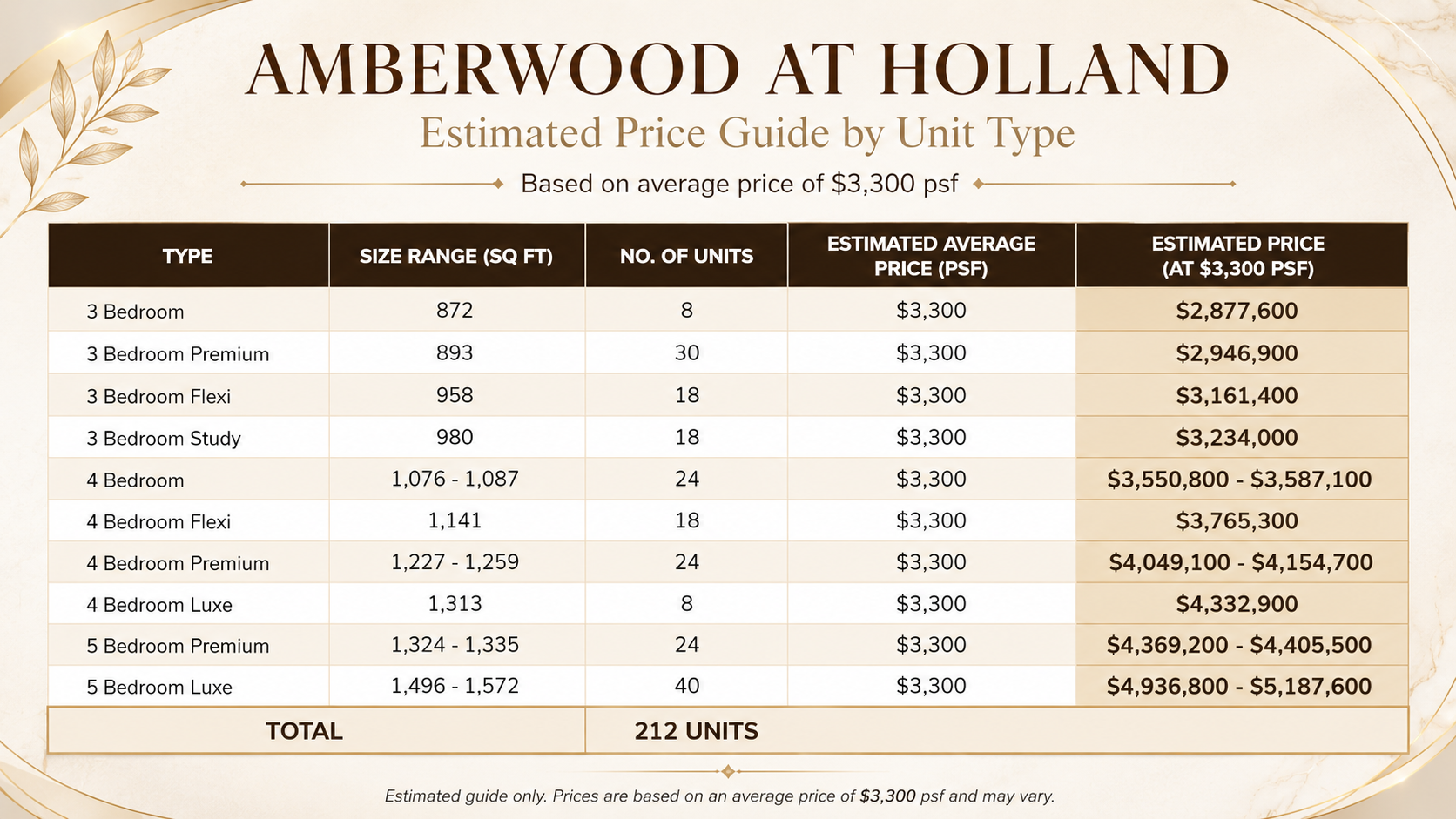
According to the project materials, Amberwood is expected to have about 212 units, with unit types ranging from 3-bedroom to 5-bedroom homes. The estimated pricing guide should be from $2,900 to $3,300. We are assuming a high estimate of about $3,300 psf, with 3-bedroom units starting from about 872 sqft, 4-bedroom units from around 1,076 sqft, and 5-bedroom units from around 1,324 sqft.
Amberwood is positioned for the upper-income segment, especially households in the top income range.
This means buyers should not only ask whether they can afford the monthly instalment.
They should also assess:
cash and CPF required
BSD / ABSD if applicable
existing property plans
TDSR position
exit strategy
whether to buy first or sell first
family timeline
Amberwood’s biggest strength: first-mover advantage in Holland Plain
The strongest Amberwood story is not just the building.
It is the location story. The Holland Plain transformation, first-mover advantage, and selling beyond PSF metrics.
This matters because first movers in a transformation precinct may benefit when buyers later understand the full future potential of the area.
The opportunity is not guaranteed, of course. Property prices can move up or down, and buyers should always evaluate affordability and risk.
But the Amberwood thesis is clear:
Buy before the Holland Plain story becomes obvious.
That is the angle serious buyers should study.
What are the risks of buying Amberwood?
A balanced review must also look at the risks.
1. PSF is high
At around $3,200 to $3,300 psf, Amberwood is not a cheap entry. Buyers must be comfortable with prime-market pricing.
2. It is not the nearest-MRT convenience play
Buyers who prioritise immediate MRT convenience may compare Amberwood against projects such as Fourth Avenue Residences or other resale options.
3. The transformation story takes time
Holland Plain is a longer-term story. Buyers should not expect immediate transformation gains overnight.
4. Exit strategy matters
The future buyer pool must be studied carefully. The likely exit audience may include families, affluent upgraders, prestige-district buyers, and buyers who value D10 positioning over pure convenience.
5. Not every unit will perform the same
Stack, facing, layout, size, entry price, and competition matter. The right unit selection is critical.
So, should you buy Amberwood?
Amberwood is not for every buyer.
But for the right buyer, it may be one of the more interesting D10 new launch opportunities because it combines:
Holland / Bukit Timah prestige
District 10 address
family-sized units
low-rise luxury positioning
limited 212-unit supply
school and family appeal
Holland Plain transformation story
potential first-mover advantage
The key is not to ask:
“Is Amberwood expensive?”
The better question is:
“Compared with future D10 replacement cost, resale alternatives, family demand, and the Holland Plain transformation, is Amberwood positioned early enough to make sense?”
That is the real discussion buyers should have before making a decision.
Final verdict: Amberwood is not a cheap project — it is a positioning play
Amberwood at Holland should not be sold as “cheap.”
It should be understood as a positioning play.
A buyer is not just buying square feet.
A buyer is buying into a District 10 address, a Holland Plain story, a low-density family environment, and the possibility of entering before the precinct matures.
For buyers who only want the lowest PSF, Amberwood may not be suitable.
But for buyers who value prestige, scarcity, family appeal, and long-term positioning, Amberwood deserves a serious look.
Before deciding, buyers should compare Amberwood not only by PSF, but by quantum, district, future supply, resale competition, transformation potential, and their own property roadmap.
FAQs
Is Amberwood at Holland expensive?
Amberwood may appear expensive by PSF, with estimated pricing around $3,200 to $3,300 psf. However, buyers should compare total quantum, District 10 location, new launch status, unit efficiency, and the Holland Plain transformation story instead of relying only on PSF.
What is the estimated price of Amberwood?
Based on the deck’s estimated guide, Amberwood’s 3-bedroom units may start from around $2.88M, 4-bedroom units from around $3.55M, and 5-bedroom units from around $4.37M, assuming an average price of about $3,300 psf.
Is Amberwood good for families?
Amberwood may appeal to families because of its District 10 location, Holland / Bukit Timah positioning, low-density environment, and proximity to established schools, including the deck’s reference to being within 1km of Methodist Girls’ School.
Is Amberwood a good investment?
Amberwood may suit buyers who believe in long-term D10 scarcity, family demand, and the Holland Plain transformation. It may not suit buyers seeking the lowest PSF, short-term flipping, or pure rental yield.
What household income is needed to buy Amberwood?
Based on the deck’s illustration, the smallest 3-bedroom unit may require an estimated household income of about $15,500/month using a 55% TDSR assumption, while larger units require higher income levels. Buyers should consult a mortgage advisor for personalised calculations.
What is Amberwood’s strongest selling point?
Amberwood’s strongest selling point is its positioning as a District 10, low-rise luxury development within the Holland Plain transformation story. Its appeal lies in prestige, family demand, limited supply, and first-mover positioning rather than cheap PSF.